There's a hiring experiment hiding in plain sight at one of the world's most sophisticated engineering organizations.
Shopify didn't roll out a mandatory AI training program. They didn't hire a Chief AI Officer to mandate tool adoption. They didn't send a 47-slide deck about "embracing the future of work."
They hired an intern per team.
And everything changed.
The Experiment Nobody Talked About
When Shopify began embedding interns inside product and engineering teams, the goal wasn't AI adoption. It was fresh perspective, cheap talent, and the usual intern rationale.
What they got was something different.
The interns, most of them 20 to 22 years old, didn't ask for permission to use AI tools. They didn't attend workshops on "responsible AI use in the workplace." They just opened Cursor, Claude, and Copilot the way they opened Slack. It was ambient. Automatic. Default.
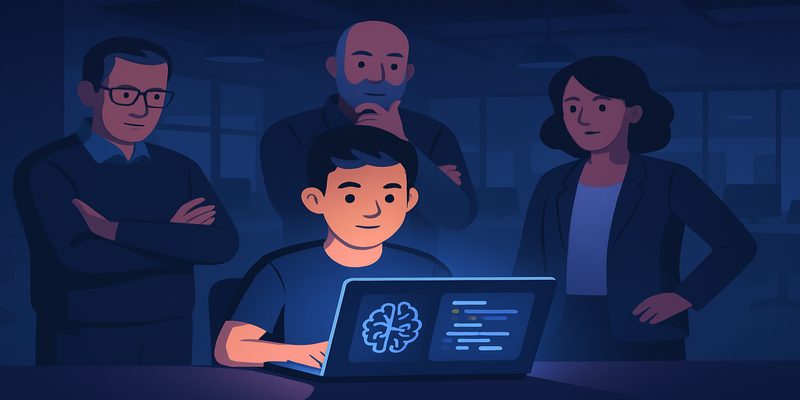
Within weeks, something interesting happened: the senior engineers started watching.
Not lecturing. Not explaining. Watching.
They saw interns debug in half the time. They saw boilerplate code written in seconds. They saw documentation that used to take an afternoon finished before lunch. The interns weren't faster because they were smarter. They were faster because they had zero baggage about what a "normal" workflow looked like.
Tobi Lütke, Shopify's CEO, has been vocal about AI being a baseline expectation at the company: not a feature, not a bonus, but a fundamental skill. In his internal communications, he made it clear: the assumption is that Shopify employees use AI tools as a matter of course. Not encouraged. Expected.
The interns weren't the experiment. They were the proof that the expectation was right.
Why Interns Are AI-Native (and Most Seniors Are Not)
There's a reason this works, and it's not age. It's formation.
Engineers who built their skills in the pre-LLM era developed muscle memory around a specific workflow: search Stack Overflow, read docs, write code manually, run tests, repeat. It's not wrong. It produced the software that runs the world.
But that workflow has a gravitational pull. When a new tool arrives, experienced engineers don't immediately abandon their groove. They evaluate. They compare. They ask: is this actually better, or am I just distracted by novelty?
Interns don't have a groove yet. They learn with the tool. The tool is load-bearing in their skill formation. Remove it and they'd feel the absence the way you'd feel the absence of autocomplete or Google search.
This is why they naturally adopted. Not because they're naive. Because they're unencumbered.
And here's the uncomfortable implication: your best senior engineers are carrying 10 years of workflow debt that AI is actively trying to pay off, and some of them won't let it.
The 2026 Hiring Filter You Didn't Know You Needed
The Shopify story points to something that forward-thinking hiring managers are already acting on:
AI fluency is no longer a bonus. It's the baseline filter.
But here's where most companies get it wrong. They test for AI fluency the same way they test for everything else: with a multiple-choice assessment, a checkbox on the job description, or a vague question in the interview like "how do you use AI in your work?"
That's not a filter. That's a formality.
Real AI fluency in engineering looks like this:
-
Knowing when NOT to use the model. Blindly trusting AI output is as dangerous as not using it at all. The best AI-native engineers have strong instincts for where models hallucinate, where they're overconfident, and where they need to be double-checked.
-
Prompt engineering under real conditions. Not the lab kind. The kind where you're debugging a production incident at 11pm and you need the model to help you triage a codebase it's never seen.
-
Working with AI agents, not just AI assistants. The jump from "ChatGPT helps me write code" to "I can deploy an agent that autonomously completes tasks in my codebase" is massive. Most engineers haven't made it yet.
-
Evaluating AI outputs as part of your review process. Not just your own work. Reviewing AI-generated PRs, AI-generated tests, AI-generated documentation. Knowing what good looks like.
Interns entering the workforce in 2026 have been using these tools for two to three years. They didn't learn them in a corporate training. They learned them in the same way they learned to use GitHub: by needing to.
The Interview Test Most Companies Are Missing
Here's a simple exercise that will tell you more about a candidate's AI fluency than any whiteboard:
- Give them a messy, undocumented codebase.
- Give them an AI tool of their choice.
- Ask them to explain what the code does and identify the most likely bugs, in 20 minutes.
Candidates who've never genuinely used AI tools in their workflow will feel the seams. They'll default to manual reading. They'll not know how to structure the prompt. They'll produce analysis that looks like what the model gave them, unfiltered.
Candidates who are truly AI-native will use the tool as a thinking partner. They'll interrogate the output. They'll push back on the model's assumptions. They'll produce something that is clearly a collaboration, and just as clearly, driven by them.
That's your hiring filter.
Not "do you use AI?" Everyone will say yes. But "can you demonstrate judgment about AI output?" That separates the 2026 engineers from the rest.
What To Do Now
If you're a hiring manager reading this in 2026, three things are worth doing immediately:
1. Add an AI workflow round to your technical interviews. Not a theory question. An actual task where candidates use AI tools and you watch how they collaborate with them.
2. Audit your current team's AI fluency. Be honest. The Shopify experiment worked because leadership was willing to learn from the interns, not just supervise them. Who on your team is actually AI-native? Who is performing AI fluency?
3. Adjust your hiring rubric. Traditional algorithm questions will not surface AI-native talent. Candidates who can architect and supervise AI agent workflows are a different profile than candidates who can reverse a binary tree on a whiteboard.
The companies that figure this out in 2026 will have a structural advantage in 2027 that compounds every year. The ones that don't will be hiring senior engineers with 10 years of workflow debt and wondering why their AI adoption is stalling.
The Quiet Revolution
The Shopify intern experiment wasn't really about interns. It was about what happens when you introduce a population of people who have no learned helplessness around AI into a team that does.
The answer: the helplessness dissolves. Not because the interns taught anyone. Because watching someone do effortlessly what you've been doing with friction is the most effective training program in existence.
That's your 2026 hiring filter.
Hire people for whom AI fluency is not a skill. It's a reflex.
At LunaPrompts, we build AI-specific hiring assessments that go beyond traditional coding tests. If you want to evaluate how your candidates actually work with AI: prompt engineering, agent workflows, LLM debugging. Our platform was built exactly for this.
References
- Shopify CEO Tobi Lütke: AI is now a baseline expectation for all employees
- Tobi Lütke on AI as a baseline expectation at Shopify (X/Twitter)
- LinkedIn's 2026 Fastest Growing Jobs Report: AI Engineer ranked #1
- McKinsey Global Institute: The State of AI in 2025
- Anthropic's Claude Code: AI-native development workflows
- GitHub Copilot adoption research: AI tools in enterprise engineering teams