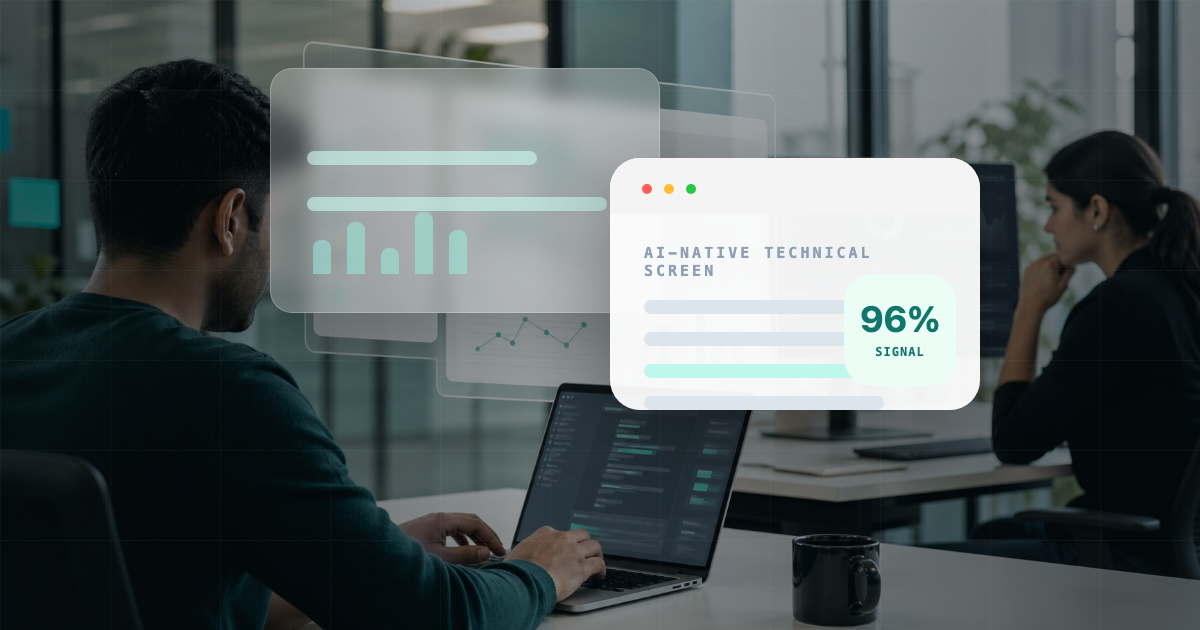
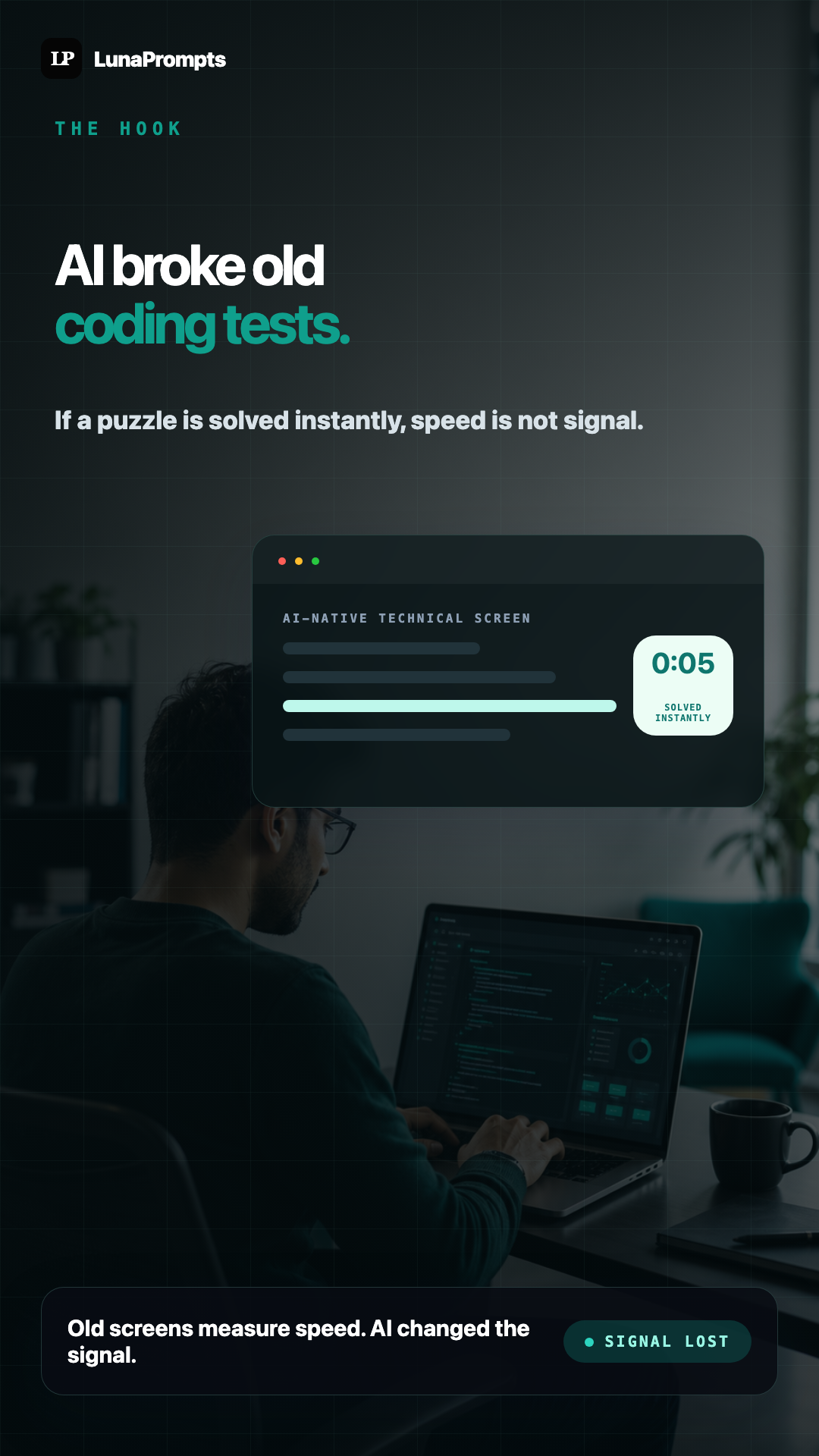
Watch the clock. If a candidate can feed your technical screen into an LLM and produce a perfect solution before the five-second timer hits zero, you have not measured their engineering talent. You have measured the model's training data.
We are witnessing a total signal lost event in technical hiring. The traditional whiteboard challenge and the isolated algorithmic puzzle have reached immediate obsolescence. When the answer is cheap, speed is a useless metric.
In the AI-native era, engineering excellence is no longer about reciting a binary search tree from memory. It is about solving complex problems by effectively directing machine intelligence. If your screen can be solved instantly, it is testing the wrong thing.
1. Hire on the Signal, Not the Noise
Most interviews are dominated by noise.
Noise is the rehearsed answer. Noise is interview-specific charisma. Noise is performance anxiety that hides a candidate's actual capability. Many legacy platforms reward people who spent months grinding LeetCode rather than people who can build and ship products.
The signal is different.
Signal is the evidence of competency revealed when you watch a candidate perform real work under real conditions. By moving the assessment into a modern, AI-augmented environment, the focus shifts from stage presence to technical output.
Interviews are noise: rehearsed answers, nerves, charisma. Watch people do your real work under real conditions, and the signal you hire on becomes unmistakable.
For hiring teams, this is the first principle of the post-LeetCode era: stop mistaking interview polish for engineering judgment.
2. Stop Banning AI. Test the Craft of Using It.
The first reaction to LLMs in hiring was predictable: ban them.
That instinct is understandable, but it is also backwards. Banning AI in a technical screen is like banning calculators in a physics exam. It does not preserve integrity. It forces you to hire for a workflow that no serious AI engineering team wants to preserve.
The real shift is moving from measuring speed to measuring steering.
Grade the Judgment
LunaPrompts replaces prohibition with participation. Candidates work with AI the way modern engineers work with AI: using model selection, prompt iteration, and parameter controls.
That reveals judgment. Does the candidate know when to be precise? Do they understand when randomness helps exploration and when it hurts reliability? Do they know how to ask for structured output, verify it, and constrain it?
Those choices are engineering choices.
Evaluate the Iteration Trace
The final code snippet is no longer the only data point. The real signal lives in the iteration trace: the path from the first prompt to the final answer.
How does the candidate handle a model failure? Do they recognize hallucination? Do they test edge cases? Do they ask the model better questions after seeing weak output?
A senior engineer is identified by how they steer the model through ambiguity, not by whether they can type syntax manually under artificial pressure.
Debug the Reasoning
In an AI-native screen, debugging becomes a first-class signal. Watching a candidate move from prompt v1 to a version that handles edge cases reveals their depth of reasoning.
You are not just looking for a pass on hidden tests. You are scoring the craft of the build.
3. The Shift from Recited to Authored Work
To identify engineers who can actually ship, companies have to move away from multiple-choice proxies and toward authored work.
The question is no longer:
Can this candidate recite the algorithm?
The question is:
Can this candidate author a system, steer the model, verify the output, and explain the tradeoffs?
That shift changes the competencies worth testing.
High-signal AI-native assessments include:
- Prompt engineering: Generating strict JSON and structured outputs without unnecessary prose.
- Agent code: Building reactive systems with agent frameworks and real code paths.
- RAG: Architecting retrieval systems that reason accurately over specific datasets.
- System design: Mapping the flow from API to queue to storage.
- SQL: Executing complex window functions, joins, and aggregation logic.
- Algorithms: Solving for performance constraints such as heaps or O(n log n) designs.
- Code review: Identifying subtle correctness or security issues inside AI-generated blocks.
But authored work needs verification. That is where AI Viva matters.
AI Viva is a voice defense. After the candidate completes the work, they defend their technical decisions out loud. They explain why the prompt was shaped that way, why the architecture uses those tradeoffs, where the risks are, and how they would improve the system.
This is the line between work that was authored and work that was merely recited.
Authored, not recited. Score the work and the integrity trail, not the candidate's stage presence.
4. Integrity Without Isolation: AI Allowed, Outsourcing Not
High-integrity hiring does not mean isolating the candidate from modern tools. It means verifying that the candidate is the one doing the work.
That distinction matters.
Using an AI model to assist with logic is part of the modern craft. Having a hidden tool or third party solve the problem is not.
LunaPrompts Secure exists for that distinction: AI allowed, outsourcing not.
Browser-only proctoring can catch some behavior, but it cannot see the full local environment. Secure mode adds a native desktop runtime and locked assessment shell for selected high-integrity assessments.
It can monitor signals such as:
- Process and argv scans: Detecting specialized cheating apps or renamed helper processes.
- Hidden window scans: Checking for capture-excluded overlays and unauthorized secondary windows.
- Network and audio signals: Identifying suspicious endpoints, virtual microphones, or screen recorder patterns.
- Identity and physical machine flow: Verifying the session is not running through a virtual machine or remote desktop setup.
The goal is not to ban AI. The goal is to separate legitimate AI-assisted engineering from fake iteration, impersonation, and outsourced answers.
That is the integrity model hiring needs now.
Proof from Real AI Hiring Funnels
This shift is already showing up in production hiring workflows. Two LunaPrompts customer stories show what happens when teams move from puzzle-speed screening to AI-native assessment data.
5. The Future of the AI-Native Technical Screen
Technical hiring has changed permanently.
If your current screen bans AI, you are not protecting your standards. You are selecting for people who either do not use the most powerful tools in the trade, or who know how to hide their use of them.
The future belongs to engineers who can steer, iterate, verify, and defend their work inside an AI-augmented workflow.
So the question for every hiring team is simple:
If your current technical screen does not allow AI, are you hiring for the world of 2018 or the world of 2026?
The companies that adjust first will hire the engineers who actually ship. The companies that do not will keep optimizing for puzzle speed while the work itself moves somewhere else.
Pilot One Role This Week
LunaPrompts helps teams run AI-native technical screens for real engineering work: prompt engineering, agent code, RAG, SQL, algorithms, code review, system design, AI Viva, and integrity reporting.
You can set up a custom challenge mix, run a pilot with 10 to 30 candidates, and compare the signal against your current process.
Book a LunaPrompts demo and pilot one role this week.
Hire AI engineers who actually ship.