 LunaPrompts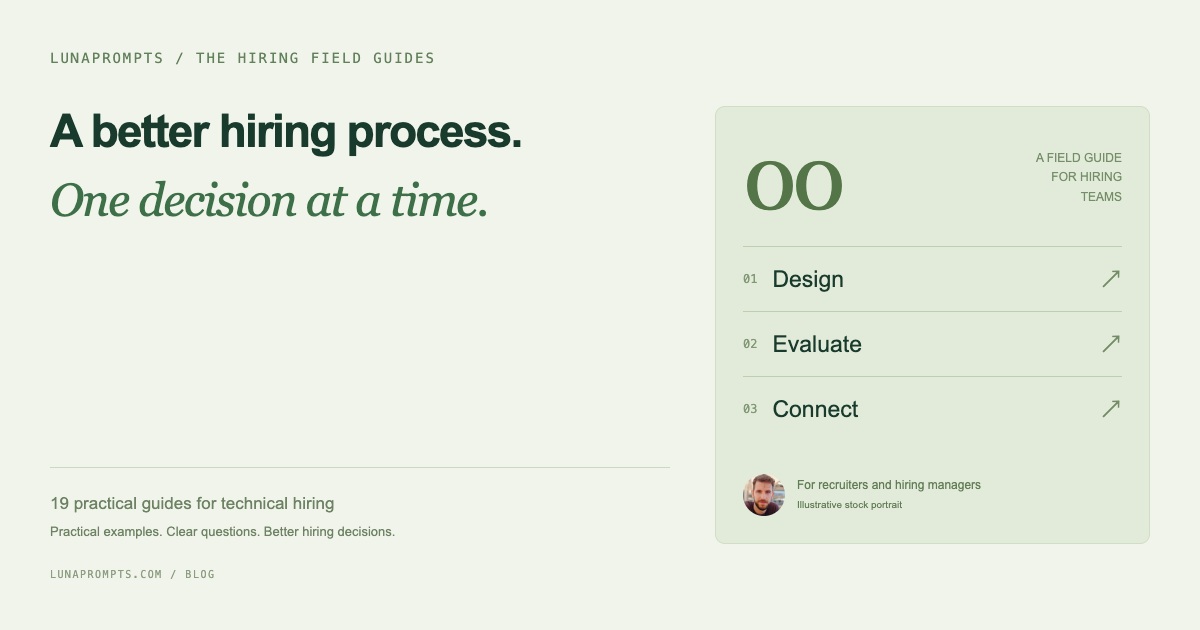
The candidate has completed the assessment. The hiring manager still has a question. The recruiter is trying to arrange the next conversation without asking everyone to start again. A good hiring workflow makes that handoff easier.
These guides focus on the decisions behind the process: what to assess, how to interpret the evidence, where automation helps, and how to keep the team connected. Each guide offers a worked example and an editable companion. The examples are illustrative, not customer case studies.
Design the assessment
A practical guide to assessing six AI skills through useful work, verification, and explanation.
Read the guide 04 / JD to assessmentThe job description is ready.The assessment still needs judgment.Translate responsibilities into an editable assessment blueprint, then calibrate the tasks, time allowance, and review criteria.
Read the guide 05 / AI coding toolsLet them use the assistant.Then inspect what they accept.Design practical tasks that reveal planning, prompting, diff review, testing, and ownership of AI-generated changes.
Read the guide 10 / Coding assessmentsThe code passes the example.What happens on the second event?Assess implementation, reading, debugging, and code review with a practical task that extends beyond the happy path.
Read the guide 11 / System designThe diagram looks complete.Change one requirement.Evaluate requirements, interfaces, data flow, reliability, and tradeoffs by asking candidates to adapt a design to a realistic constraint.
Read the guide 18 / Question randomizationDifferent questions.The same skills to demonstrate.Build question variation around skill coverage, expected effort, and review criteria instead of assuming random selection creates equivalent tests.
Read the guide 19 / MCQ assessmentsA good question has a reason.So does every wrong answer.Design scenario-based multiple-choice questions with clear assumptions, plausible distractors, and a practical follow-up.
Read the guideEvaluate fairly
How to review possible unauthorized AI assistance, ask a useful follow-up, and document a decision your hiring team can explain.
Read the guide 06 / Candidate analyticsThe scores match.The follow-ups should not.Use skill results, test outcomes, revisions, and explanations to prepare better interviews without overinterpreting telemetry.
Read the guide 07 / AI VivaThey have the answer.Ask what would change it.Use short, submission-specific follow-ups to explore understanding, adaptation, and the limits of a candidate’s solution.
Read the guide 09 / Interview copilotThey already took the test.Make the interview add something.Turn assessment evidence into an interview plan and connect findings across rounds without asking candidates to repeat the same work.
Read the guideRun the process
A practical guide to per-test costs, subscription comparisons, campaign planning, and the candidate time that still matters.
Read the guide 08 / AI interviewsMore first conversations.A clearer handoff to people.Plan a structured AI-led first round with role-related questions, candidate communication, review capacity, and purposeful human follow-ups.
Read the guide 12 / Candidate discoveryThe right title is not enough.Find a reason to invite them.Build a shortlist around role requirements, keep profile sources visible, and turn promising experience into demonstrated evidence.
Read the guide 13 / Recruiting copilotsGive the agent a task.Give the exception a person.Scope candidate evaluation, information gathering, scheduling, and phone screens with clear completion states and human handoffs.
Read the guideConnect the team
Evaluate an assessment integration by its invitations, application records, completion states, result delivery, and recovery paths.
Read the guide 15 / Unlimited seatsThe right reviewer is busy.Do not make access another hurdle.Understand no-per-seat pricing, plan reviewer responsibilities, and give occasional specialists the context they need.
Read the guide 16 / FDE supportYour role is specific.Your assessment should be too.Scope an FDE engagement around representative tasks, calibration, enterprise workflows, and practical acceptance criteria.
Read the guide 17 / Talent CRM“Assessment complete” is a status.Who owns what happens next?Keep candidate records, evaluation context, and next actions connected, with clear ownership alongside your ATS.
Read the guideWhere should your team start?
Hiring AI engineers? Start with AI skills assessment, then connect AI coding tools with AI Viva. Together they address the work, the environment, and the candidate’s explanation.
Preparing a campus campaign? Explore AI interviews, unlimited tests, and question randomization. Plan review capacity and candidate communication alongside volume.
Improving enterprise handoffs? Read the ATS integration guide, Talent CRM guide, and FDE support guide. Use them to clarify ownership, data flow, and acceptance criteria.
How these guides are prepared
LunaPrompts Editorial develops these guides from the product brief, available product documentation, and original assessment examples. External technical references are linked where used. Each article distinguishes a suggested review practice from a product capability and avoids treating an illustrative number as a customer result.
The intended reader is a hiring team making a practical decision. Suggested tasks and review frameworks need calibration for the actual role. A score, an automated recommendation, or a single session event should be interpreted with the relevant evidence and context.
Product setup, supported integrations, available environments, and scoped services should be confirmed for your account. For a concrete walkthrough, bring your hiring workflow to the LunaPrompts team.